Technical and legal framework
This service sits within a framework of statutory duties, technical rulebooks and operational practice. The distinction matters because it determines who is responsible for what.
- Legal status of VDI 2052
- VDI 2052 is a private technical guideline of the Association of German Engineers and is not a legal norm. It creates no immediate statutory duty; the wording 'legally required under VDI 2052' misstates the legal position. A technical review of the standard in its full text is required.
- What actually creates the duty
- Four mutually independent routes: the operator's duty of care pursuant to § 823 BGB and the Workplace Ordinance, the requirements of the insurance contract, the client's specifications under a lease, tenancy or service contract, and building regulations law together with the property's fire protection concept. For the contractor, the contractual specification is the most practically effective obligation.
- Insurance
- Property insurers set out requirements for the maintenance of fire-endangered systems and, in the event of a loss, examine whether the operator has met its maintenance duty. If documented maintenance cannot be evidenced, the insurer may raise the objection of gross negligence and reject the settlement in whole or in part. That is a risk, not a certainty; whether an objection holds is decided on the individual facts. What governs is the wording of the insurance contract.
- Fire dampers
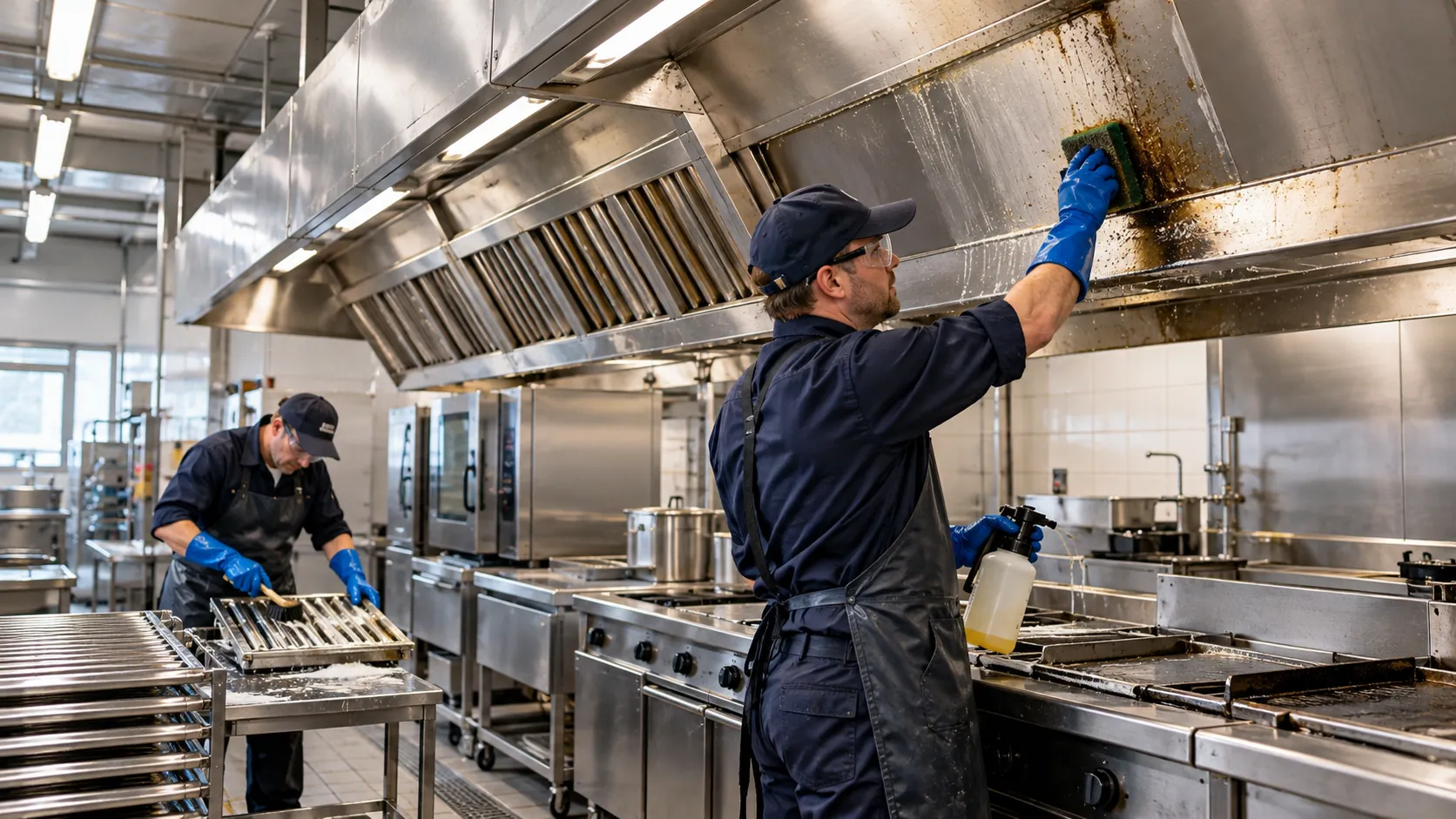
- Fire protection installations are subject to recurring inspections, the scope of which follows the law of the relevant federal state and the individual property. Cleaning of the kitchen exhaust is to be distinguished from this, but touches on it: a damper blocked by resinified grease does not perform its isolating function. The functional test remains the operator's task.
- Food hygiene
- For food business operators, the cleanliness of rooms and equipment is mandatory under Regulation (EC) No 852/2004. An exhaust route from which grease drips onto work surfaces or products contradicts that requirement – irrespective of any fire protection consideration. Food control authorities ask about this differently from the way a property insurer does.
- What evidence is produced
- A cleaning contractor issues a work and cleaning report: the finding, the work carried out, anything unusual, photographic documentation. That is not an official certificate and not a declaration of conformity. Whether an insurer, an expert or an authority recognises this report is decided by the body concerned.
The rulebooks named here describe requirements for how the work is carried out – they are not a certification held by BREREI. VDI and DIN normative texts are chargeable and were not available in full; where a statement touches the normative detail, this is noted in place.