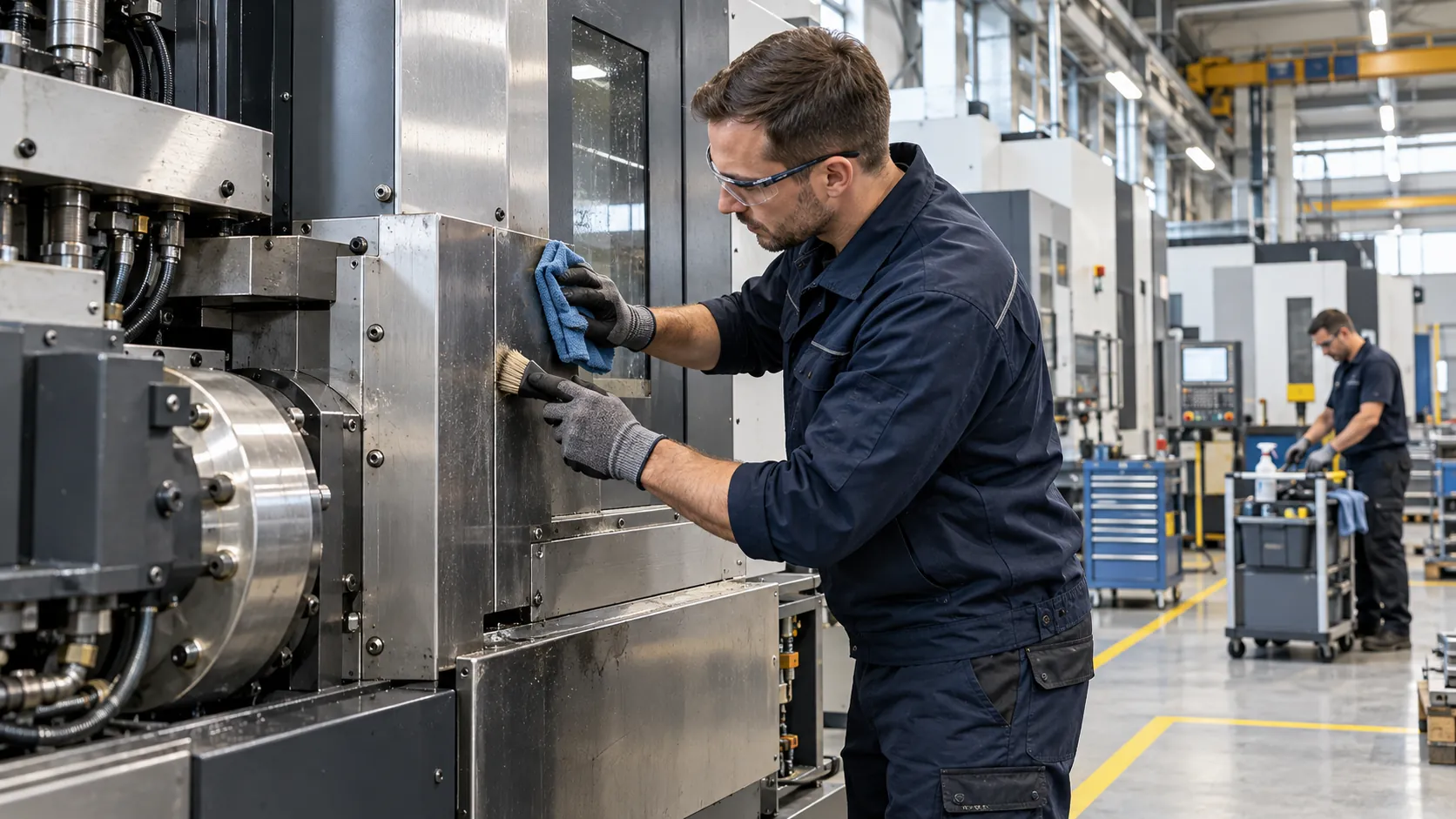
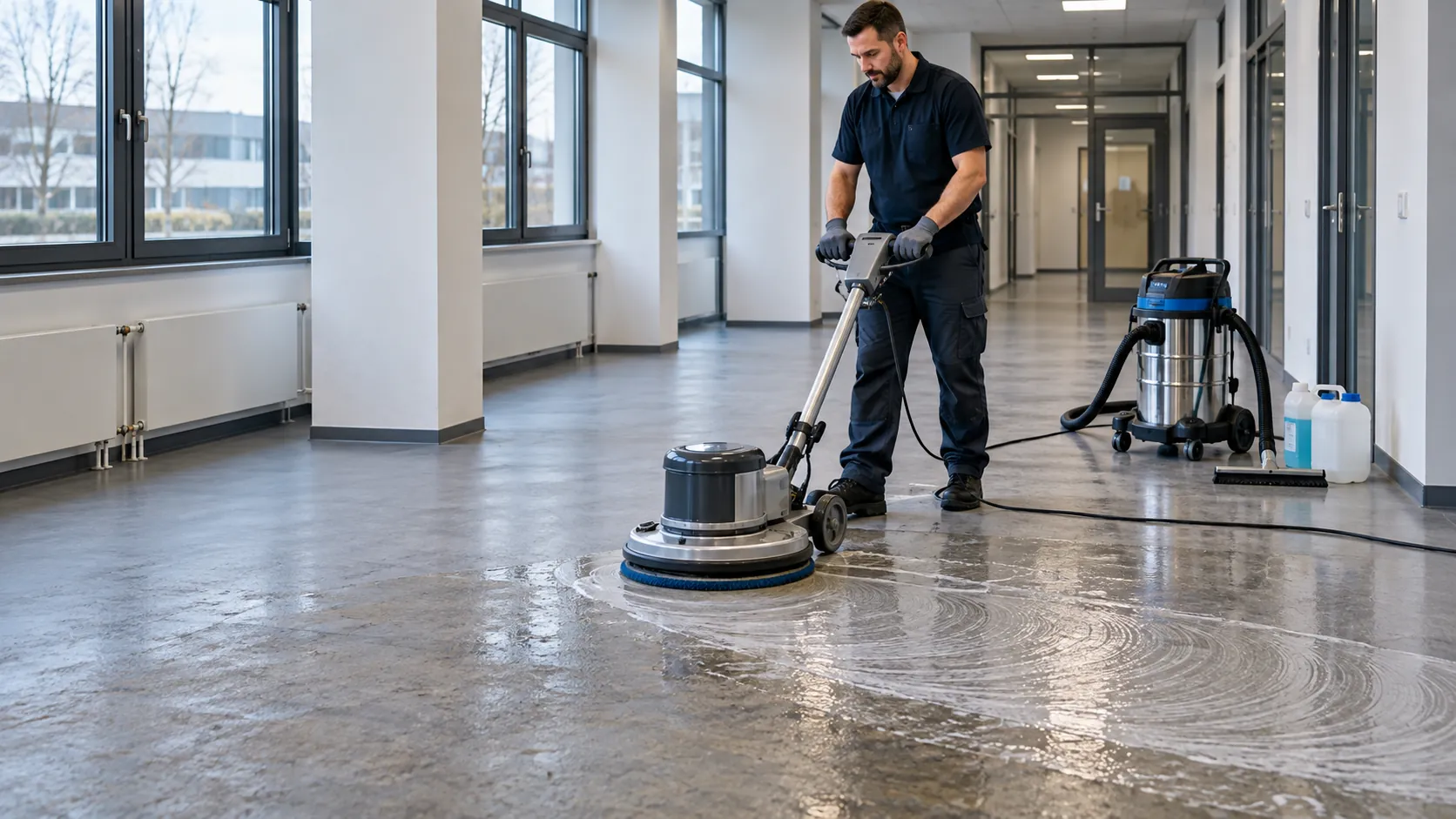
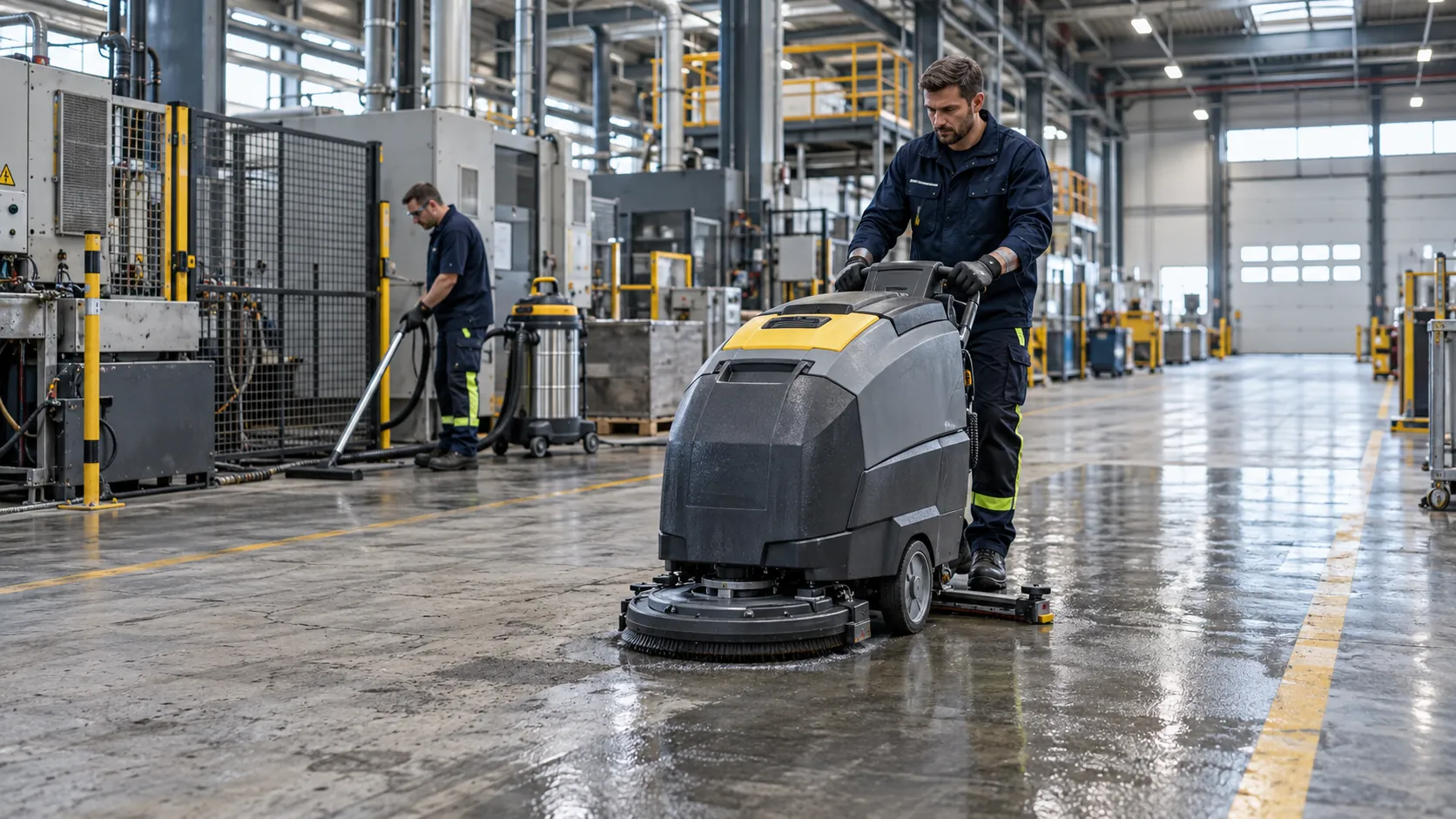
Scrubber-dryer cleaning a production hall floor while equipment is vacuumed in the background

Industrial cleaning in Bremen: production areas, industrial floors and plant

What determines the effort is not the square metres but the shutdown window, the type of contamination and the route the waste water can take.

Request a site survey

Category
Industrial cleaning
Reachable
Mo–Fr 07:30–17:30 Uhr
Site visit
Free of charge, on site

In short

Industrial cleaning covers production areas, industrial floors, traffic routes and plant in manufacturing and warehousing. What matters is less the floor area than the boundary conditions: the production shutdown window, the route the waste water takes, and the operator's risk assessment. That wastewater route dictates the method – where no separation can be organised, work is water-minimal or dry.

Problem und Lösung

The challenge

An industrial operation rarely looks for a contractor because the floor is dirty. The trigger is usually an inspection by the employers' liability insurance association, documented oil contamination on a traffic route, a scheduled overhaul, a change of ownership of the hall, or a window in which everything that cannot be done during running operations has to be completed. On top of that comes the open question of where the rinse water is actually allowed to go if the separator is too small or not designed for cooling lubricants. The common denominator: cleaning competes with production time, and every hour of downtime has to be justified. What is needed, therefore, is not a catalogue of methods but a reliable statement about which window will be occupied, who prepares what, and how the result is evidenced.

Our solution

The site is inspected, the type of contamination is determined, and the substrate and drainage are recorded. The work area is then cut off and covered, and solids and swarf are picked up dry before any wet cleaning so that they do not enter the drainage system. Deep cleaning follows the substrate, the contamination and the possible wastewater route. Finally, the water-oil mixture and the residues that arise are collected, and the condition of the traffic routes is recorded in a joint inspection. Who takes on disposal and record-keeping must be stated explicitly in the quotation.

Scope of service

  • Cleaning of production areas and traffic routes: hall floors, driveways and loading zones, including removal of oil, grease, cooling lubricant and rubber abrasion.
  • Degreasing and preparation of surfaces before new installation or hall handover – grease and oil films, production residues, old floor markings.
  • Walls, ceilings and load-bearing structures indoors: removal of welding fume, soot and dust deposits.
  • Pits, channels and swarf and oil separator tanks: desludging, vacuuming and clearing out of the collection points.
  • Cleaning close to machinery: degreasing of the machine surroundings, the foundation areas and the feed lines – without interfering with the plant itself.
  • Choice of method according to substrate, contamination and wastewater route: where no separation can be organised, work is carried out with little water or dry.
  • Coarse removal before any wet cleaning: swarf, solids and loose dirt are picked up first so that they do not enter the drainage system.
  • Safeguarding and covering of control cabinets, sensors, control systems, stored goods and conveyor technology – including the subsequent release for use.
  • Coordination with the shutdown window: the work is attached to an existing overhaul, shift-break or holiday window instead of creating one of its own.
  • Clearance, disposal and record-keeping: the type and quantity of residues, the acceptance point and the accompanying waste notes are explicitly governed in the quotation.

Typical subservices

  • Industrial floor and traffic area cleaning
  • Degreasing and oil removal
  • Channels, pits and separator tanks
  • Machine surroundings and foundation areas
  • Walls, ceilings and load-bearing structures
  • Hall handover and interim condition during conversion

Suitable for

  • Metalworking and machining – hall floors with cooling lubricant and swarf ingress, traffic routes for industrial trucks.
  • Steel and heavy fabrication – large contiguous areas, welding fume on load-bearing structures, badly accessible edge zones.
  • Plastics and rubber processing – abrasion, release agents and dusts, some of them combustible.
  • Automotive suppliers and assembly – paced lines in which cleaning is only possible during defined breaks.
  • Logistics and transhipment areas at port and commercial sites – bulk material residues, rubber abrasion, alternating indoor and outdoor surfaces.
  • Maintenance workshops and test bays – heavy oil and grease loads on a limited area.

Your advantages

Tailored to this service – aligned with site and industry.

  • The wastewater route dictates the method

    If no separation can be organised, a low-water or dry method is the obvious choice – not because it cleans better, but because it avoids the wastewater route.

  • Explosion protection concerns the equipment

    ATEX governs the machines that may be used in a defined zone, not the cleaning method. The claim 'ATEX-cleaned' is therefore misleading.

  • Slip resistance remains the operator's task

    A wet or greasy surface is more slippery during the work than before, and aggressive degreasing can permanently alter the slip-resistant structure of a floor.

Process

How your project runs

  1. 1

    Site survey and risk assessment

    Determine the type of contamination, record the substrate and coating, check drainage and separators, assess accessibility.

  2. 2

    Define the shutdown or partial window

    If cleaning during running operations is not possible, it is attached to an existing window instead of creating one of its own.

  3. 3

    Safeguarding and covering

    Cut off the work area, protect control cabinets, sensors, control systems, stored goods and conveyor technology, and release them again afterwards.

  4. 4

    Coarse removal, then deep cleaning

    Swarf, solids and loose dirt are picked up first. A wet or dry method then follows, depending on the substrate, the contamination and the drainage options.

  5. 5

    Recovery, acceptance and report

    Collection of the water-oil mixture and the residues, joint inspection, report and photographic documentation, establishment of the condition of the traffic routes.

Methods and equipment

  • Wet or dry cleaning depending on substrate, type of contamination and drainage options – the choice is a considered trade-off, not a matter of taste.
  • Coarse removal before wet cleaning: swarf, solids and loose dirt are picked up first so that they do not enter the drainage system.
  • Degreasing of surfaces, machine surroundings and load-bearing structures; removal of welding fume, soot and dust deposits indoors.
  • Desludging and vacuuming of pits, channels and separator tanks as the dedicated collection points of the production operation.
  • Safeguarding and covering of control cabinets, sensors, control systems and conveyor technology before and during the work.
  • Separate collection on site of the water-oil mixture and the residues that arise; the route to the acceptance facility is clarified in advance.

Technical and legal framework

This service sits within a framework of statutory duties, technical rulebooks and operational practice. The distinction matters because it determines who is responsible for what.

Who is responsible
The duty to clean falls on the operator: as owner under the duty of care towards persons on the premises pursuant to § 823 BGB, and as employer under occupational health and safety law. The cleaning contract organises this duty; it does not transfer it.
Waste water and water law
As soon as water containing mineral oil, emulsion or cooling lubricant is set in motion, water law applies (WHG, AwSV) – a binding statutory regime, not a recommendation. Discharge into the public sewer requires an official permit and technical separation. If that is not organised, a low-water or dry method is the obvious choice. A technical review of the standard in its full text is required.
Slip resistance of traffic routes
Traffic routes in workplaces must be safe to walk on; the basis for this is the Workplace Ordinance. For practical implementation, workplace rule ASR A1.5 'Floors' is used – not a legal norm, but with a presumption effect within the framework of the Ordinance. During cleaning, a wet or greasy surface is more slippery than before. Assessing slip resistance remains the operator's task. A technical review of the standard in its full text is required.
Risk assessment and external contractors
The operator prepares the risk assessment for its own operation and instructs the external contractor deployed: isolations and lock-off, barriers, escape routes, alarm raising, behaviour in the event of faults. Cleaning staff are not visitors; they work with equipment and chemicals in the place where production happens. The contractor assesses its own activity and provides evidence of its instructions to staff.
Explosion protection and ATEX
Where combustible dusts or solvent vapours can occur, the operator defines zones and maintains the explosion protection document. The ATEX Product Directive 2014/34/EU is a binding EU directive and concerns the equipment that may be used in those zones – not the cleaning method. What therefore has to be clarified is whether the equipment deployed is approved for the zone in which it is used.
The cut-off at handover
During the work, securing the work area lies with the contractor; for the condition after handover, with the operator. This cut-off must be stated explicitly in the contract. DGUV Vorschrift 1 binds the contractor as a member business and governs cooperation with external contractors.

The rulebooks named here describe requirements for how the work is carried out – they are not a certification held by BREREI. VDI and DIN normative texts are chargeable and were not available in full; where a statement touches the normative detail, this is noted in place.
What determines the interval

  • Quantity introduced per unit of time: machining with an open cooling lubricant circuit produces more deposit than an assembly line with closed systems.
  • Type of contamination: oil mist and emulsion settle and migrate, soot and dust stay where they land, salt and bulk material residues are seasonal.
  • Traffic density and type of industrial truck: solid rubber tyres leave abrasion that combines with oil to form a sticky layer.
  • Drainage situation: if wet cleaning is possible, more frequent partial cleaning is feasible. Without a separator, the deployments shift to shutdown windows.
  • Condition of the floor coating: an intact coating is easier to clean than bare, absorbent concrete.
  • Requirements of third parties: conditions arising from inspections, insurance terms, customer or owner requirements, imminent audits.
  • Shutdown calendar: company holidays, overhaul weeks and conversion work are the natural pace-setters.

What determines the effort and the quotation

  • Accessibility: racking aisles, gaps between machines, pits and projections cost a multiple per square metre of what a clear hall costs
  • Type of contamination and age of the soiling: a fresh oil film is a different job from hardened oil crust or baked-in soot
  • Choice of method: low-water and dry methods reduce disposal effort but can be slower
  • Effort of safeguarding and covering for control cabinets, sensors, control systems, stored goods and conveyor technology
  • Number and shape of the shutdown windows: one deployment in a single block is cheaper than the same scope split across several short windows
  • Disposal route: type, quantity and composition of waste water and residues, distance to the acceptance facility, need for accompanying waste notes
  • Depth of evidence: photographic documentation, reports, measurements and release certificates
  • Work at height and special access: work on load-bearing structures, ceilings and pipe bridges requires additional equipment and time

Applicable standards and regulations

  • WHG / AwSV – legally binding
  • Occupational Health and Safety Act and Workplace Ordinance – legally binding
  • ASR A1.5 'Floors' – workplace rule, not a legal norm, presumption effect via the Workplace Ordinance
  • DGUV Vorschrift 1 – accident prevention regulation, binding on member businesses
  • TRGS 500 – Technical Rule for Hazardous Substances with presumption effect under the Hazardous Substances Ordinance
  • ATEX 2014/34/EU – binding EU product directive, concerns equipment, not methods
  • VDI 2263 – VDI guideline, not a legal norm; takes effect through contract, insurance condition or customary practice
  • § 823 BGB – statutory liability provision, duty of care towards persons on the premises

These references describe the requirements the work is performed against. They are not a certification, inspection or approval held by BREREI.

Frequently asked questions about this service

Short answers to help you assess whether this service fits your site.

Can the work take place during running production?

That depends on the contamination and on the method. Dry work with extraction can often be carried out in sections alongside operations, provided the work area is cut off and the release procedure is settled. As soon as water with an oil or emulsion content is involved, aerosols and a wastewater route arise – both argue for a shutdown or shift-break window. A blanket commitment would be unprofessional; the decision is taken during the site survey.

How is the waste water disposed of?

Water containing mineral oil, emulsion or cooling lubricant must not enter the sewer unchecked. The usual approach is separate collection on site and handover to an approved acceptance facility with documentation. Whether your own separation system can be used depends on its design and on the official permit. Both must be clarified before the work, not during it – and stated explicitly in the quotation.

Does cleaning change the slip resistance of the floor?

Yes, in both directions. A floor free of oil and grease is grippier than before. At the same time, strongly alkaline or acidic cleaners and abrasive pads can attack the slip-resistant micro-structure of a coating. The substrate is therefore recorded in advance and the chemistry matched to it. Assessing slip resistance remains an operator task; ASR A1.5 is the recognised working basis for this, not a legal norm.

Who prepares the risk assessment?

The operator prepares the risk assessment for its operation and provides the operational information; the contractor assesses its own activity and provides evidence of its instructions to staff. What you should set out in the tender or the contract: who supplies the operational documents, who may authorise isolations, and how the instruction of the staff deployed is evidenced before their first assignment. In practice this only works if both documents fit together.

How is the result accepted?

The usual approach is a joint inspection at the end of the assignment with a report and photographic documentation, broken down by area. It makes sense to name the acceptance criteria in advance: visual inspection, residual soiling, grip, condition of the drainage. Set these criteria out in the tender already – without criteria agreed in advance, acceptance turns into a negotiation, and additional charges are all but inevitable.

Is cleaning possible in potentially explosive areas?

Only with equipment that is approved for the zone defined there, and only within the framework of the operator's explosion protection document. The ATEX Product Directive governs equipment, not the method; the claim 'ATEX-cleaned' is therefore misleading. Clarify the zone classification and the permitted equipment in advance and, where required, a gas-free measurement – and record both in the contract.

Industrial cleaning for your shutdown window

A reliable quotation requires a site survey: describe the property, the type of contamination, the accessibility and the window in which work can be carried out. The method, preparation, wastewater route, disposal and acceptance criteria are stated explicitly in it.

Prefer to talk?

0421 87757597

Mon–Fri, 07:30–17:30 – we are happy to call you back.

Request a quote in two minutes

Service, property and contact details – that is all we need.

Or use the full contact form