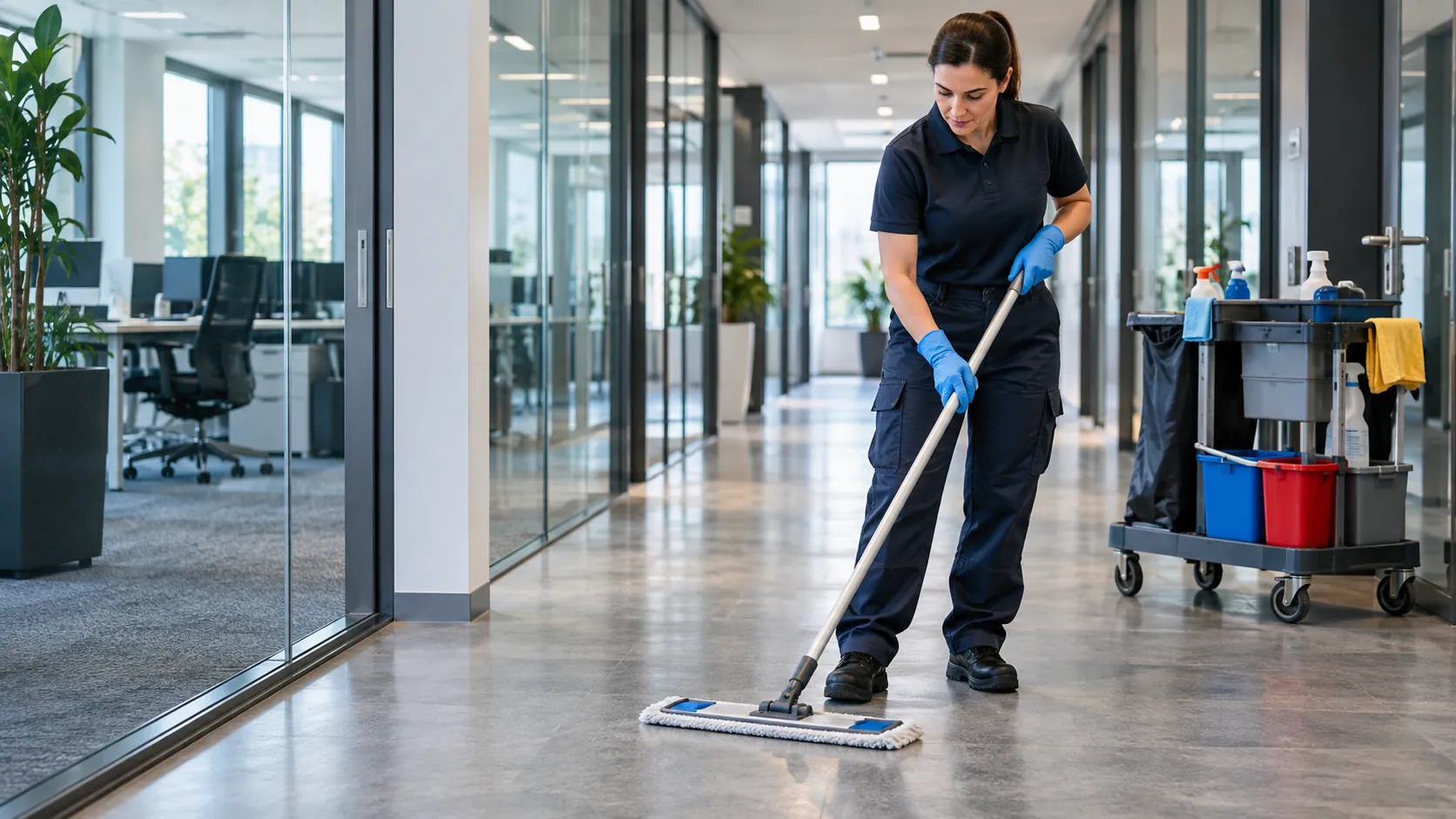
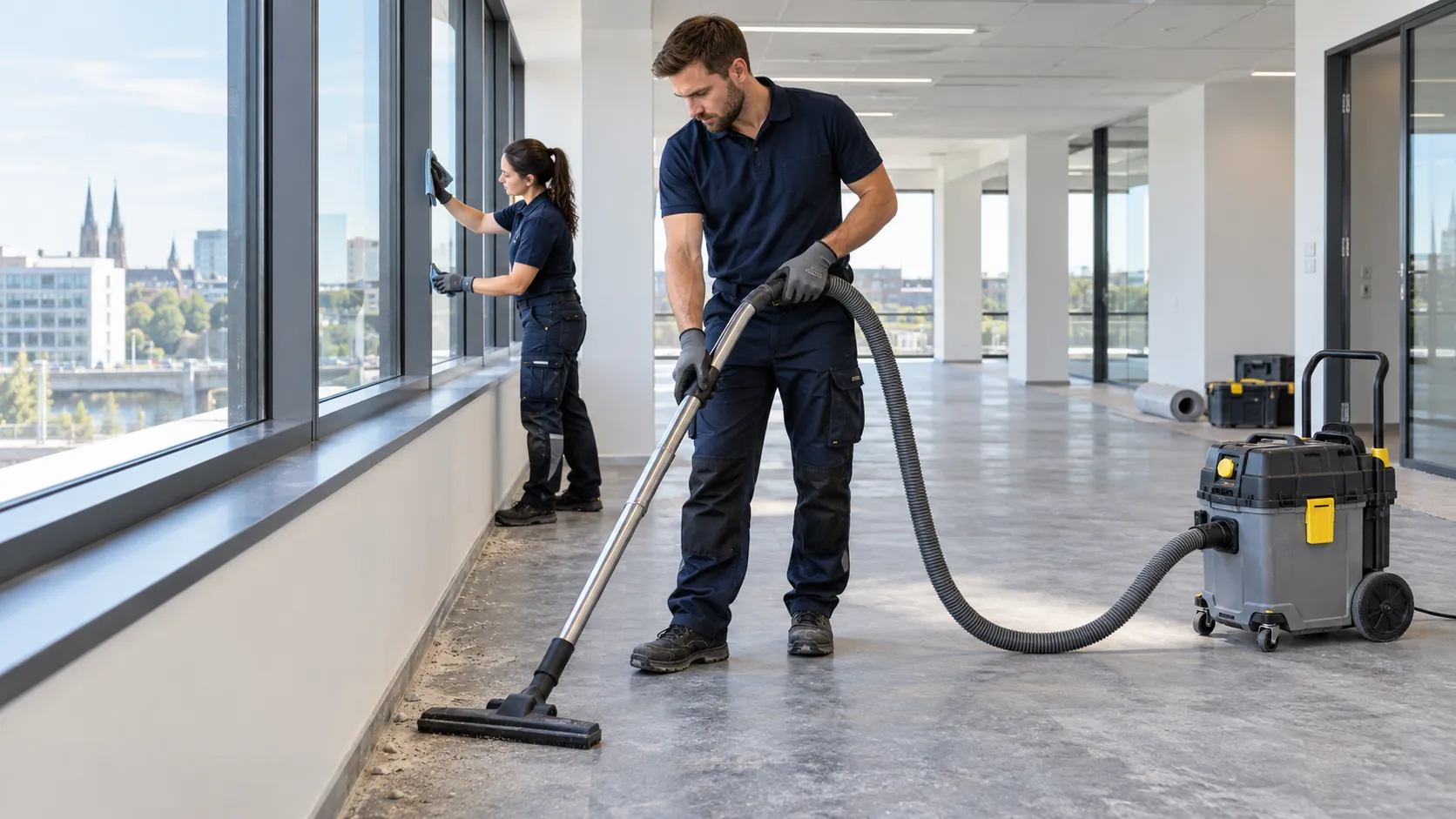
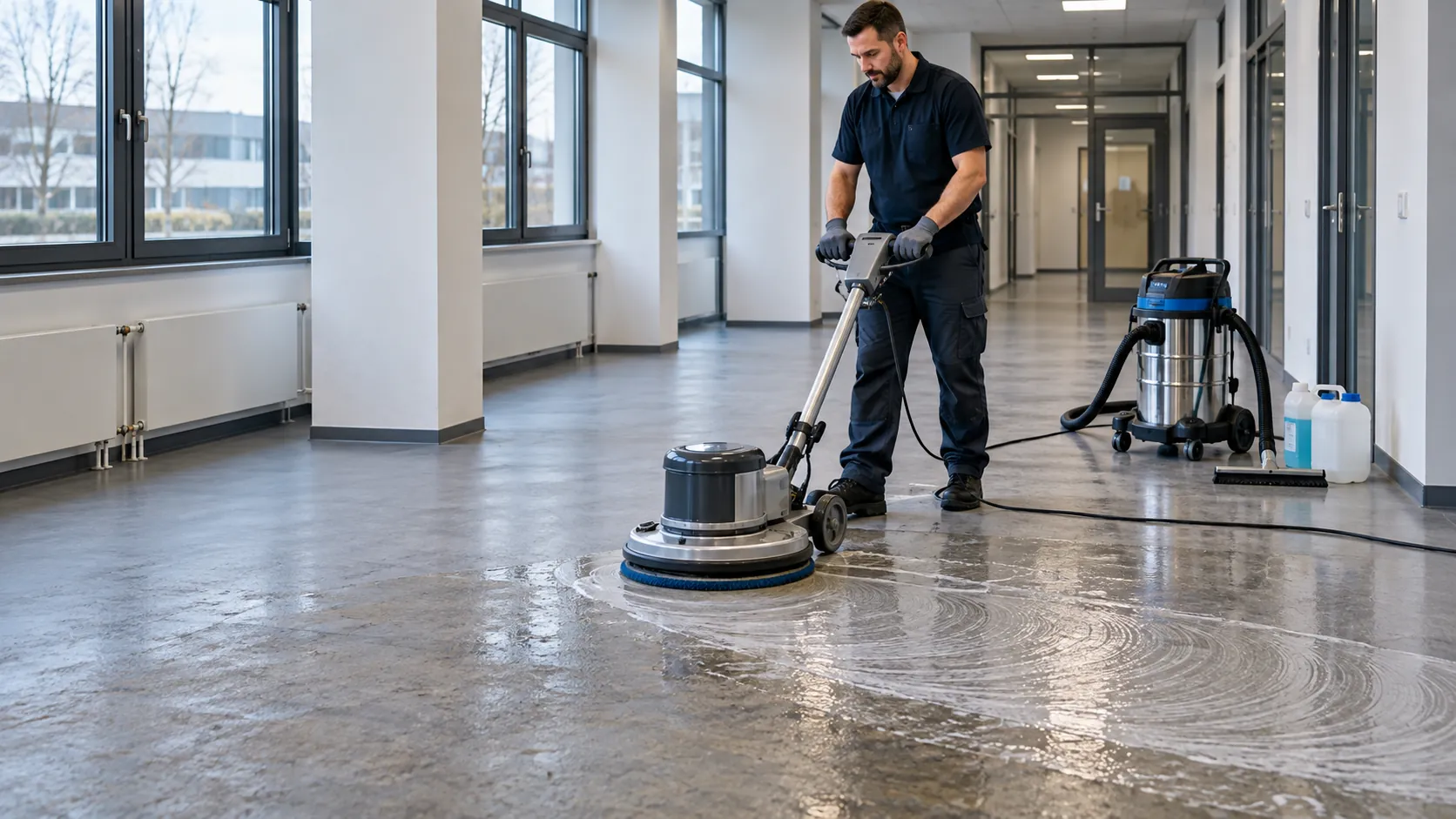
Deep cleaning a commercial floor with a single-disc machine and a wet vacuum

Deep cleaning in Bremen: the covering sets the method – stripping the care film and applying a new one

The covering decides which stripping method is permissible, not the machine: what is right on a design floor covering destroys linoleum.

Discuss your covering

Category
Building cleaning
Reachable
Mo–Fr 07:30–17:30 Uhr
Site visit
Free of charge, on site

In short

Deep cleaning returns a floor covering to its raw state: it strips old care films, encrusted soil and traffic lanes, extracts the loosened slurry wet and neutralises the surface. Only then can a new care film follow. Which method is permissible is decided by the covering alone: alkaline strippers destroy linoleum, rubber and calcareous natural stone. The area stays closed off while it dries.

Problem und Lösung

The challenge

The trigger is almost always a visible finding that the running cleaning has no explanation for: the floor looks dull rather than even after mopping, because surfactant-based maintenance cleaners build up a care film layer by layer – a sacrificial polymer layer that is meant to wear away instead of the covering itself. Traffic lanes are back within a few days – a sign of missing stripping, not of cleaning that is too infrequent. The surface has greyed because fine sand particles from the entrance zone act like an abrasive; the covering is then not dirty but mechanically attacked. And often a site inspection has raised the question of slipping hazards without it being clear whether cleaning is the right answer at all. The common denominator: this is not about cleanliness but about the condition of the covering.

Our solution

It starts with the diagnosis: the covering and its wear layer are determined, joint proportion, pre-existing damage, discolouration and existing coating layers are recorded. Chemistry, mechanics and pressure follow from that – not the other way round. A fixed sequence then applies: stripping the old layers with a dwell time, wet extraction of the soiled solution before it dries, neutralisation and clear rinsing, drying and only then a new care film. Every step is named in the schedule of services as an item of its own, because each one decides the result.

Scope of service

  • The subject of the contract is the property-specific schedule of services, which sets out the sequence as named individual items – from the diagnosis to the release for use.
  • Condition survey and covering diagnosis: determination of the covering and its wear layer, assessment of joint proportion, pre-existing damage, discolouration and any coating layers already present.
  • Stripping of the old care layers: application of a material-compatible deep-cleaning agent with a dwell time, then mechanical treatment with a single-disc machine, pad or brush roller – depending on the covering and the layer thickness.
  • Extraction of the soiled solution: the loosened slurry is extracted wet before it dries. If it dries in, the polymer that was stripped off is deposited on the surface again.
  • Neutralisation and clear rinsing: alkaline residues of the stripping agent are removed and the surface is brought back into the neutral range.
  • Drying: the covering has to be dry before a care film is applied. Residual moisture, especially in joints and at transitions, leads to adhesion faults and inclusions.
  • Care film or coating as a separate item: multi-layer application in a crosswise pattern with flash-off times between the layers. Whether it is ordered and with which system is decided by the covering and belongs in the tender in advance.
  • Resilient coverings: PVC, CV and design floor coverings are as a rule the surfaces that classic stripping followed by a polymer coating is meant for.
  • Sensitive coverings: linoleum, rubber and calcareous natural stone are handled with adapted chemistry – rubber vapour-permeable, calcareous stone without acid, cement joints on the other hand with an acidic descaler.
  • Acceptance and release for use: a joint visual inspection and agreement on the point from which the area may be fully used again.

Typical subservices

  • On-site covering diagnosis
  • Stripping of old care films and polymer layers
  • Wet extraction of the soiled solution
  • Neutralisation and rinsing
  • Deep cleaning during usage breaks
  • Deep cleaning before a change of tenant and handover

Suitable for

  • Education facilities – corridors, assembly halls and classrooms with linoleum or rubber, high usage density; the work is done during the holidays.
  • Care homes and hospital property – coverings that have to resist surface and hand disinfectants; a coating must not form stains there.
  • Office buildings and public authorities – public traffic and entrance zones with a high soil ingress.
  • Retail and sales floors – appearance and slip safety have a direct effect on business; the work is done outside opening hours.
  • Production and logistics ancillary areas – staff, changing and sanitary areas with tiles, porcelain stoneware and a high joint proportion.
  • Commercial property changing tenants – the handover demands a defined condition and is often the real trigger.

Your advantages

Tailored to this service – aligned with site and industry.

  • The covering decides, not the machine

    Alkaline strippers destroy linoleum, rubber and calcareous natural stone. Anyone who uses the same cleaning agent on PVC, linoleum and rubber causes damage in one of the three cases that no second pass will put right.

  • Neutralisation is a work step

    A coating does not adhere permanently to an alkaline surface. It flakes off or forms blisters, often only after weeks – by then the connection remains hidden and it looks like a product defect.

  • A care film as preparatory work for the cycle

    The protective film is preparatory work for daily routine cleaning: an intact film extends the interval to the next stripping and keeps abrasive particles away from the covering. How the care film should look therefore belongs in the tender.

Process

How your project runs

  1. 1

    Condition survey and covering diagnosis

    The covering and its wear layer, joint proportion, pre-existing damage, discolouration and existing coating layers are determined. The result is the decision on chemistry, mechanics and pressure.

  2. 2

    Stripping of the old care layers

    A material-compatible deep-cleaning agent is applied and left to act; mechanical treatment with a single-disc machine, pad or brush roller follows – depending on the covering and the layer thickness.

  3. 3

    Extraction of the soiled solution

    The loosened slurry is extracted wet before it dries. If it dries in, the polymer that was stripped off is deposited on the surface again and the work step was ineffective.

  4. 4

    Neutralisation and rinsing

    Alkaline residues are removed and the surface is brought back into the neutral range. This is the step most often left out, and it is the precondition for any care film holding at all.

  5. 5

    Drying, care film, release

    A new care film only adheres to a dry covering; residual moisture in joints and at transitions leads to inclusions. Whether a coating follows has to be settled beforehand as an item of its own. At the joint acceptance the point is agreed from which the area may be fully used again.

Methods and equipment

  • Stripping: a material-compatible deep-cleaning agent with a dwell time, then mechanical treatment with a single-disc machine, pad or brush roller. The choice follows the covering and the layer thickness, not whichever machine happens to be available.
  • Wet extraction: the loosened soiled solution is taken up while it is still liquid. Stripping that is left to dry is wasted work, because the polymer is deposited again.
  • Neutralisation and clear rinsing bring the surface back into the neutral range – the precondition for the adhesion of any coating that follows.
  • Separate chemistry in mixed properties: cement joints and limescale deposits on ceramics are treated with acid, while calcareous natural stone such as marble is attacked by that same acid. Both surfaces therefore require separate working agents and a clear sequence of sections.
  • Sensitive coverings: linoleum, a natural product made of linseed oil, wood flour and jute, reacts to strongly alkaline cleaners with discolouration and embrittlement; rubber is treated vapour-permeable, because a closed film makes it swell.
  • Care film: multi-layer application in a crosswise pattern with flash-off times between the layers. Layer build-up and gloss level follow the covering and the use, the product system follows the manufacturer's specification.

Technical and legal framework

This service sits within a framework of statutory duties, technical rulebooks and operational practice. The distinction matters because it determines who is responsible for what.

Who owes the duty of care
§ 823 BGB obliges anyone who opens an area to use by others to keep it safe. That risk includes slipping through wetness, through slipperiness or through friction that is low because of the material itself. The cleaning contract reduces this risk, it does not transfer it: the operator remains responsible, including during the work and after the area has been released for use.
Alkaline strippers and the covering
Choosing the deep-cleaning agent is a question of material with hard consequences. Linoleum discolours and becomes irreversibly brittle, rubber is designed to be vapour-permeable, calcareous natural stone is attacked by acid, while cement joints actually need acid to remove limescale. Hence the real statement of this service: there is no deep-cleaning method that works independently of the covering. A quotation given before the diagnosis is an estimate.
Slip resistance is a product property
Floors are classified in slip-resistance classes; the evidence is provided through the product and the way it is laid or coated. Cleaning does not restore a slip-resistance class. What a care film can do is replace the protective film that has been stripped away, so that friction is not lost through bare, mechanically attacked covering. Anyone who wants a class assured has to describe it as a product property of the system used, with supporting documentation.
Rulebooks and their status
The Ordinance on Workplaces is legally binding; the Technical Rules for Workplaces give it concrete form with presumption effect and are not a legal norm in the strict sense. DIN 77400 is a standard, not a law: its purpose is to make cleaning services describable and verifiable; it becomes binding through contract, legal reference or presumption effect. No law prescribes deep cleaning at a particular interval. Technical review of the standard in its full text is required.
Working in an occupied building
Stripping and coating products are hazardous substances within the meaning of the Ordinance on Hazardous Substances; handling them requires a substitute-product assessment and protective measures. If the work takes place in an occupied building, that belongs in the property planning: ventilation, closing off the area and routing for the users. Safety data sheets and manufacturer information are the reliable basis for specific application values, not the tender.

The rulebooks named here describe requirements for how the work is carried out – they are not a certification held by BREREI. VDI and DIN normative texts are chargeable and were not available in full; where a statement touches the normative detail, this is noted in place.
What determines the interval

  • Usage intensity: an entrance corridor with public traffic uses up a protective film in a different time than an administrative wing without customer traffic.
  • Soil ingress from outside and how it is intercepted: where soil-retention zones are missing or too short, every grain of sand acts as an abrasive well into the building.
  • Presence and condition of a coating: an intact protective film extends the interval to the next stripping considerably; without one it shortens.
  • Choice of maintenance product for the running cleaning: cleaners rich in surfactants build up the wipe film faster, and that film then has to be stripped.
  • Covering: linoleum and rubber are handled differently from resilient coverings with a polymer coating.
  • Windows without usage during the year: holidays, plant shutdowns and conversion breaks determine when closing off the area is possible at all – often the real pace-setter.
  • Occasion rather than rhythm: on a change of tenant, a handover or an acceptance the deep cleaning follows a date, not an interval.

What determines the effort and the quotation

  • Covering and wear layer: they determine the method and the chemistry and therefore the time required. Where laying records, manufacturer information and documents on earlier coatings are available, that shortens the diagnosis and lowers the risk of damage.
  • Number of existing old coatings: every layer costs another stripping pass.
  • Area and layout: interrupted areas with many edges take more work than one large, open area. Joint and groove proportion as well as the degree of furnishing come on top as cost drivers of their own.
  • Care film: yes or no, and with which layer build-up. This point decides a substantial part of the effort and has to be settled in advance as an item.
  • Drying conditions: room climate, ventilation options and temperature determine how long the area stays closed off. In winter or in basement floors the window lengthens considerably.
  • Closure time and preparation by the client: cleaning and drying together make up the time window. Clearing the area including furniture, an alternative route for closed main corridors, water and power connections as well as space for machines belong in the tender.
  • Work outside operating and opening hours, section-by-section work in live operation, plus acceptance and documentation.
  • Disposal of the soiled solution and the separated residues: where discharge is not permitted, containment and a disposal route are needed. This logistics and disposal element has to be clarified in advance.

Applicable standards and regulations

  • Ordinance on Workplaces (ArbStättV)
  • § 823 BGB – duty of care towards persons on the premises
  • Ordinance on Hazardous Substances (GefStoffV)
  • DGUV Vorschrift 1 – accident prevention regulation, binding on member businesses
  • Technical Rules for Workplaces (ASR)
  • DIN 77400
  • Manufacturer information on cleaning, stripping and coating systems

These references describe the requirements the work is performed against. They are not a certification, inspection or approval held by BREREI.

Frequently asked questions about this service

Short answers to help you assess whether this service fits your site.

How do you recognise that deep cleaning is due?

From four findings that mostly occur together: the floor looks dull rather than even after cleaning; traffic lanes show up again within a few days; the surface feels sticky or attracts soil noticeably fast; and there is a visible build-up of layers, often at edges, transitions and in corners. All four point to the same thing: there is a film on the surface that the running cleaning no longer removes.

How long is the area unusable after deep cleaning?

That cannot be said across the board, because three times add up: the cleaning time itself, the drying time of the covering and, if a care film is applied, the flash-off and curing time of the coating. The total depends on the covering, on the product and above all on the room climate. The critical figure is therefore not the cleaning duration but the window in which the area has to stay closed off. That is exactly what weekends, holidays and shutdown periods are used for.

Does a new coating or care film always have to follow deep cleaning?

No. Stripping removes the existing care film; whether a new care film follows is decided by the covering and the demands made on it. Rubber coverings, for instance, are treated vapour-permeable and do not receive a closed film, linoleum can be given a satin care film but does not have to be, while heavily used PVC and design coverings benefit clearly. The order matters: first ask what the covering needs. What you should set out in the tender: whether the care film is part of the order or a separate item, and which product information has to be submitted for it.

Which coverings must not be treated with alkaline deep-cleaning agents?

The most sensitive are linoleum, a natural product made of linseed oil, wood flour and jute, and rubber, as well as calcareous natural stone such as marble. Linoleum reacts to strongly alkaline cleaners with irreversible discolouration and embrittlement, rubber is impaired in its vapour-permeable structure, and calcareous stone is attacked by acidic agents while cement joints positively need acid to remove limescale. That is why every deep cleaning starts with the diagnosis of the covering and not with the choice of machine.

Can deep cleaning be carried out section by section in live operation?

Yes, and often that is the only realistic route. The area is then divided into sections that are worked one after another and released individually. That takes more time than working straight through, because machines and staff have to be moved several times and interim arrangements are needed for the routes people take. The advantage: operations do not have to stop entirely. It makes sense on large, subdivided areas, not on a continuous corridor that cannot be closed off halfway.

How are tiles, joints and natural stone treated?

Here two requirements meet that can rule each other out. Cement joints and limescale deposits on ceramic coverings are usually treated with acid, while calcareous natural stone such as marble or travertine is attacked by exactly that acid and loses its surface. In properties where both occur, work therefore has to be done section by section with different chemistry and clearly separated working agents. What you should set out in the tender: whether a joint treatment is also wanted that delays soiling again – it is an item of its own and not an ancillary service.

Request deep cleaning

The next sensible step is a site visit with a look at the floor: type of covering, existing coating layers, joint proportion, damaged areas and the time window in which the area can be closed off. That survey replaces any remote diagnosis.

Prefer to talk?

0421 87757597

Mon–Fri, 07:30–17:30 – we are happy to call you back.

Request a quote in two minutes

Service, property and contact details – that is all we need.

Or use the full contact form