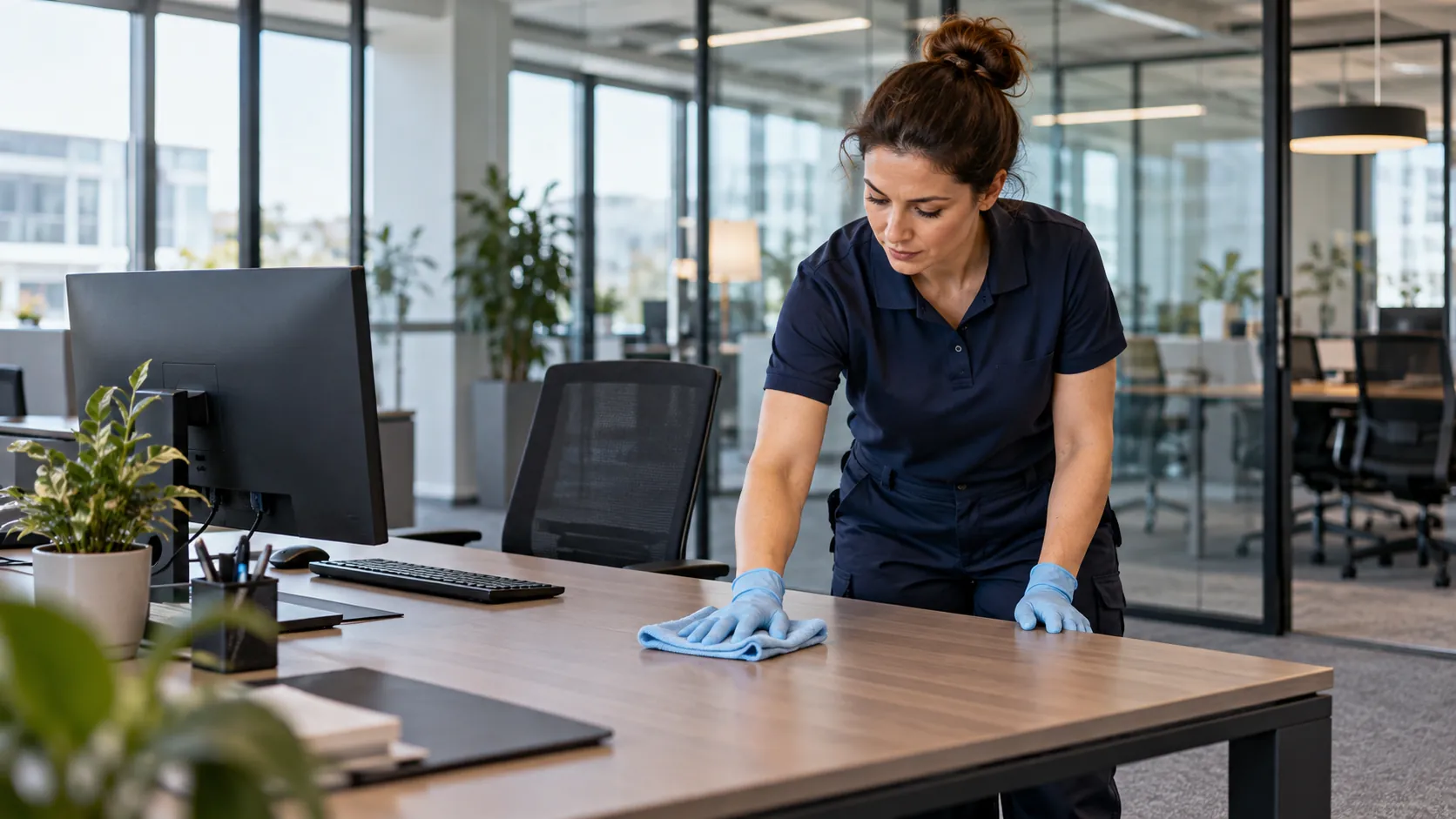
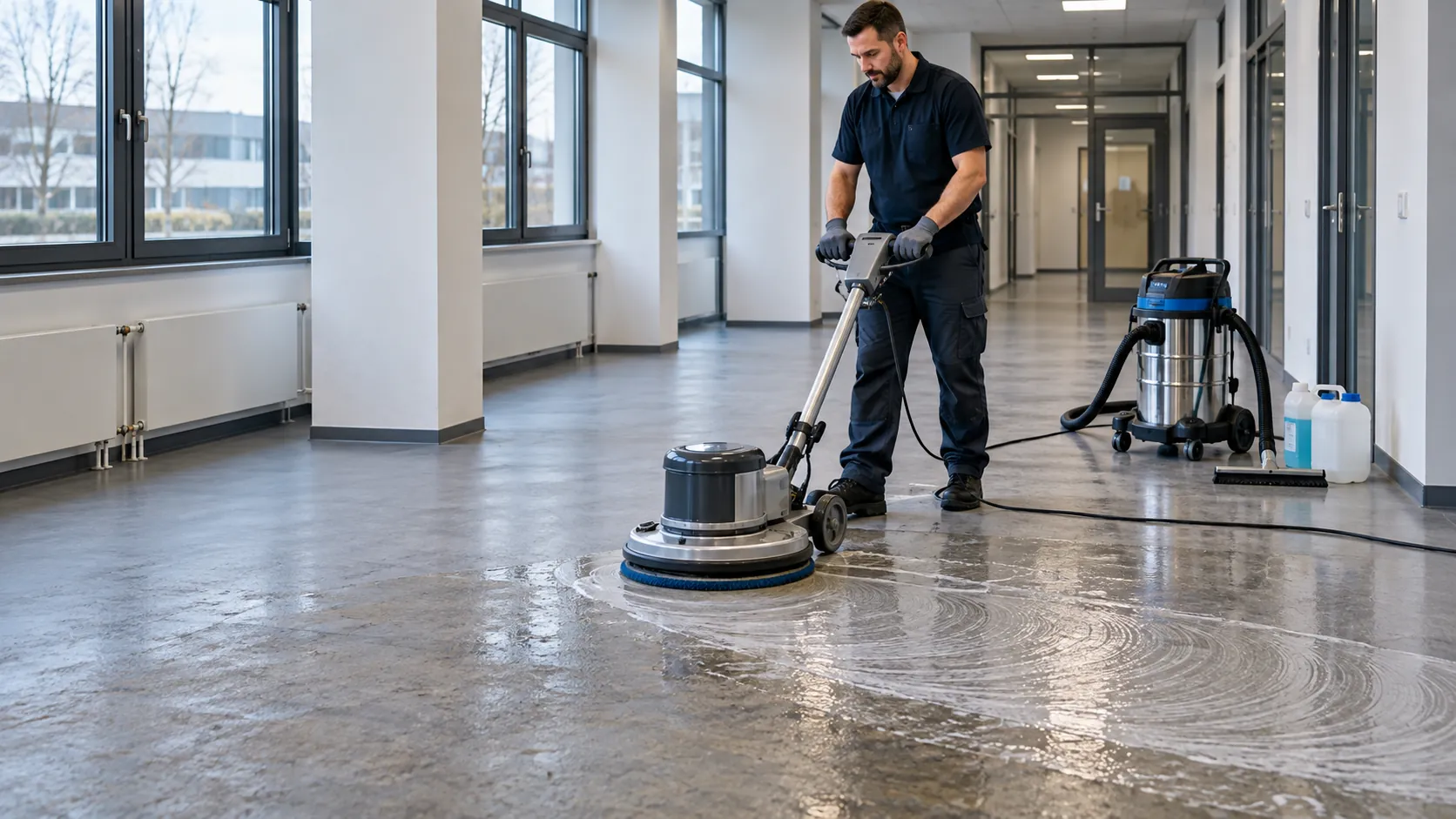
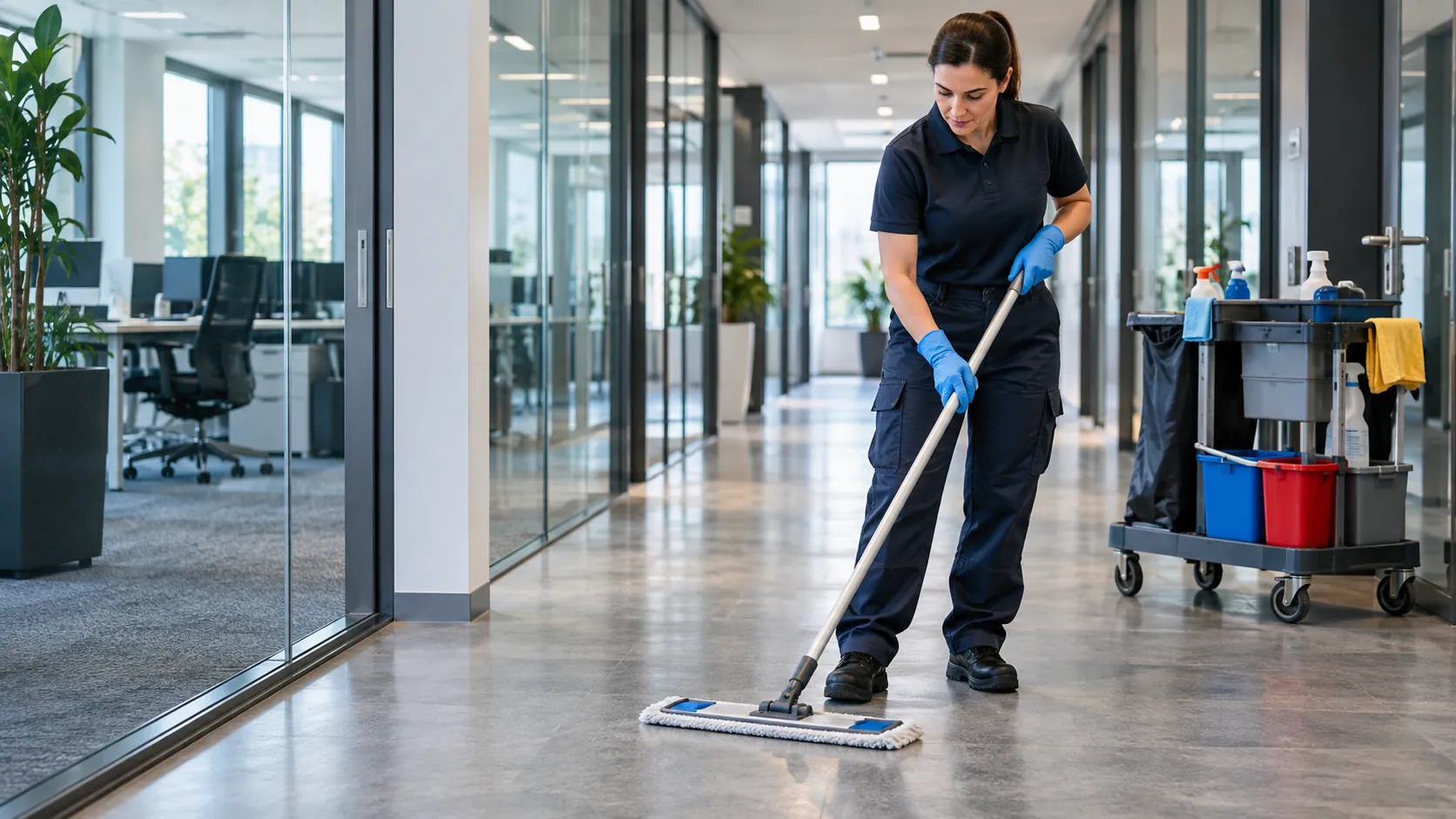
Cleaner mopping an office corridor with a flat mop next to a cleaning trolley

Routine cleaning in Bremen: intervals, room schedule and value retention in live operation

Recurring cleaning maintains a defined condition. The workload is set by room groups, usage frequency and time windows – not by floor area alone.

Discuss your property

Category
Building cleaning
Reachable
Mo–Fr 07:30–17:30 Uhr
Site visit
Free of charge, on site

In short

Routine cleaning is the recurring cleaning of a property at an agreed interval. It maintains a defined condition, but it does not remove care films built up over years – that is what deep cleaning is for. The workload is determined by the room schedule, usage frequency and time windows, not by floor area alone.

Problem und Lösung

The challenge

The trigger is rarely “we need cleanliness”. Usually a contract is coming to an end, or the cleaning delivered so far is not perceived as what is being paid for: edge zones are left untouched, sanitary areas are treated only where visible, consumables are replenished irregularly, staff change. The common core is rarely a lack of cleaning performance but the absence of a describable service: frequency, room group and acceptance criterion are written down nowhere.

Our solution

The property is divided into room groups, scope and frequency are defined for each room group and recorded in a schedule of services. That turns “clean” into a verifiable subject matter of the contract: every item is named, every frequency traceable, every deviation open to discussion.

Scope of service

  • The subject of the contract is the property-specific schedule of services with scope and frequency per room group.
  • Circulation areas, entrance areas and stairwells: wet cleaning of walked-on surfaces, handrails, balustrades, finger marks on glass doors, soil-retention zones.
  • Sanitary areas: wet cleaning of WCs, urinals, washbasins, taps and mirrors; replenishment of soap and paper towels where agreed.
  • Offices and workrooms: cleaning of the clear surfaces – desk surface, meeting table, window sill. Documents and objects are not moved.
  • Kitchenettes and staff welfare areas: work surfaces, sink, taps and the exterior surfaces of coffee machine, microwave and refrigerator.
  • Floor coverings separated by material: vacuum textile coverings, damp-wipe hard coverings. The method follows the covering, not the room.
  • Waste: emptying the decentralised bins in the property and changing liners. Disposal remains the client's task as the waste producer.
  • Area-specific separation of cleaning equipment by colour coding, in order to prevent transfer from sanitary areas to other areas.
  • Consumables such as soap, paper and liners: procured by the client or supplied as a separate goods delivery – this must be expressly regulated in the schedule of services.
  • Stairwell, corridor and shared areas in apartment buildings: walkable surfaces, handrails, the letterbox unit, the bin area and basement access. In residential properties the cycle is often shorter than in office space, because use is spread across the whole day instead of being confined to working hours.

Typical subservices

  • Office cleaning
  • Stairwell cleaning
  • Sanitary care
  • Common rooms
  • Floor care
  • Internal glazing

Suitable for

  • Office buildings and administrations – many users, high sanitary demand, a representative entrance.
  • Law firms, tax consultancies and practices – with access restrictions and a requirement for discretion.
  • Retail and branches – cleaning before opening; shop windows and the checkout area as the most visible surfaces.
  • Mixed-use commercial properties – office, warehouse, workshop and staff welfare areas under one roof.
  • Logistics and commercial parks – the office and welfare wing as routine cleaning area, while the hall is a service in its own right.
  • Housing companies and property managers – stairwells, corridors and shared areas in apartment buildings, often on the same cycle as the bin area and the outdoor grounds.

Your advantages

Tailored to this service – aligned with site and industry.

  • Frequency per room group

    No blanket cycle for the whole building, but an agreed frequency per room group – a sanitary area differs from an ancillary area.

  • A service that can be described

    Scope, frequency and acceptance criterion are set out in the schedule of services. That makes the service verifiable instead of a matter of interpretation.

  • The boundary to deep cleaning

    When a higher frequency stops achieving anything and the covering has to go back to its raw state – before the wrong service is put out to tender.

Process

How your project runs

  1. 1

    Survey the property

    Surfaces, room groups, finishes and sanitary areas are walked; usage frequency and time windows are noted.

  2. 2

    Draw up the schedule of services

    Scope and frequency are recorded for each room group – the basis for pricing and for later inspection.

  3. 3

    Clarify access and organisation

    Keys or transponders, handover and receipt, contacts, consumables, storage space for equipment.

  4. 4

    Start with a site induction

    The team is inducted into the property; property-specific hazards and areas with access restrictions are documented.

  5. 5

    Adjust the room schedule as needed

    If usage changes – conversion, an additional floor, more public traffic – the interval and the room schedule need to be aligned.

Methods and equipment

  • Maintenance methods: sweeping, vacuuming and damp mopping in one or two passes, wiping of surfaces, wet cleaning in sanitary areas.
  • The method follows the covering and the type of soiling, not the room: textile coverings are vacuumed, resilient hard coverings damp-wiped, mineral coverings treated according to their joint proportion.
  • Cleaning equipment is separated by area so that nothing from sanitary areas is transferred to other areas via the mop.
  • The service can be described by frequency per room group and is therefore verifiable – that is the precondition for any quality control.

Technical and legal framework

This service sits within a framework of statutory duties, technical rulebooks and operational practice. The distinction matters because it determines who is responsible for what.

Who is responsible
The cleaning obligation falls on the operator of the property: as owner under the duty of care towards persons on the premises, as employer under occupational health and safety law. The cleaning contract organises this obligation, it does not transfer it. However complete the contract, it does not release the client from responsibility for the safety of their premises.
Type of contract
Ongoing routine cleaning is mainly handled as a contract for services: what is owed is the activity at the agreed frequency and quality, not a guaranteed end condition. Deep or post-construction cleaning with a defined result, by contrast, is regularly described as a contract for work. What is enforceable in a complaint depends on this classification.
Occupational health and safety
Towards the cleaning staff, the contractor is the employer and therefore responsible for the instruction and risk assessment of its own staff. The client remains responsible for the hazards that their property brings with it: access routes, lighting, electrical installations, escape routes and the handling of their own systems. Property documentation must therefore be mutual.
Hygiene
The German Infection Protection Act obliges certain establishments – such as medical practices and care facilities – to meet hygiene requirements. For an ordinary office building it provides no legal basis for disinfection services. Anyone who puts disinfection out to tender should justify it on hygiene grounds, not with a law that does not apply here.
DIN 77400
A standard, not a rule of law. Its purpose is to make cleaning services describable and verifiable – exactly the function that the schedule of services fulfils. It becomes binding through contract, legal reference or presumption effect, not through itself. Professional review of the standard in its full text is required.

The rulebooks named here describe requirements for how the work is carried out – they are not a certification held by BREREI. VDI and DIN normative texts are chargeable and were not available in full; where a statement touches the normative detail, this is noted in place.
What determines the interval

  • Usage frequency rather than area: circulation areas and sanitary areas scale with the number of people using them, not with square metres.
  • The way the room schedule is cut: only the division into circulation, office, sanitary, staff welfare and ancillary areas makes frequency controllable at all.
  • Soil ingress from outside: entrance zone, soil-retention matting, weather conditions, customer footfall and location within the city.
  • Covering and proportion of surfaces: a foyer with large-format hard covering behaves differently from a mix of carpet, rubber and glass.
  • Operating model: cleaning during live operation is more demanding to organise than cleaning after the end of business – routes, barriers and consideration for others are added.
  • Additional requirements: the lease, house rules, official conditions or a hygiene plan can in practice prescribe a minimum interval.

What determines the effort and the quotation

  • Area per room group as the base quantity
  • Frequency per room group – it multiplies the base quantity
  • Density of surfaces and furniture: determines whether an area can be treated in one pass or in several
  • Number of sanitary fixtures as a separate cost driver independent of area
  • Floors and travel distances: travel time with no cleaning effect
  • Time window: unsocial hours, night or weekend work increase the staffing input
  • Cleaning during live operation: barriers, coordination, interruptions
  • Consumables and stockholding, documentation effort, plus contract term and notice period

Applicable standards and regulations

  • Ordinance on Workplaces (ArbStättV)
  • German Civil Code (BGB) § 823 – duty of care towards persons on the premises
  • DGUV Vorschrift 1 (binding accident-prevention regulation for member businesses)
  • DIN 77400
  • Closed Substance Cycle Waste Management Act (KrWG)

These references describe the requirements the work is performed against. They are not a certification, inspection or approval held by BREREI.

Frequently asked questions about this service

Short answers to help you assess whether this service fits your site.

How often should routine cleaning take place?

There is no generally correct interval. What matters is usage frequency, room groups, soil ingress and the level of presentation expected. A property with public traffic needs a different frequency in the sanitary area and entrance zone than in ancillary rooms. A blanket cycle for the whole building therefore makes no sense; what makes sense is a frequency per room group, set out in the schedule of services.

When is deep cleaning due instead of a higher frequency?

When the dirt no longer lies on the surface but in and on a care film. Typical signs: the floor looks dull after cleaning, traffic lanes come back within a few days, the surface attracts dirt noticeably quickly. A higher frequency treats the same symptom more often without touching the cause. First the covering has to go back to its raw state; after that the normal interval applies again.

Who provides cleaning agents, equipment and consumables?

Cleaning agents and equipment are usually brought by the contractor; they are part of its service. Consumables for sanitary and staff welfare areas – soap, paper, liners – are handled differently: either the client provides them, or the contractor supplies them as a separate goods delivery. Both are permissible; what matters is that this is expressly stated in the schedule of services. Otherwise disputes regularly arise over replenishments that nobody ordered.

How are access and keys arranged?

Documented key or transponder management with a written receipt, named allocation and return on staff changes is usual. Two points should be clarified before the contract is signed: whether a locking system is used that allows inexpensive reprogramming if a key is lost, and whether the scope of cover of the contractor's liability insurance actually includes loss of a key. The existence of liability insurance is one question, its scope of cover the other.

What happens during holidays, sickness or staff changes?

This is the weak point of every cleaning contract and should therefore be a subject of the contract, not a matter of trust. Three things need regulating: how quickly cover is provided, how the stand-in is inducted into the property, and who bears the cost of a familiarisation period. A stand-in without knowledge of the property delivers less in the first few visits – that is not a reproach but a planning factor.

How is the service delivered documented in a traceable way?

On two levels. First through the schedule of services: frequency and room group are the yardstick. Second through evidence of attendance and of the items carried out. How that evidence is kept in technical terms – paper list, site file or digital capture – differs considerably between providers. The client should specify in the tender which evidence they want rather than leaving it to the provider.

Request routine cleaning

A sound quotation needs a site visit, not a price list: areas, room schedule or existing plans and the desired interval are enough to start.

Prefer to talk?

0421 87757597

Mon–Fri, 07:30–17:30 – we are happy to call you back.

Request a quote in two minutes

Service, property and contact details – that is all we need.

Or use the full contact form